21 Squadron War Diary
The National Archives' reference AIR 27/271/398SECRET MARCH, 1945. WAR DIARY OF
21 SQUADRON, SOUTH AFRICANAIR FORCE.1945.MARCH JESI LANDING GROUND, ITALY.The improved weather conditions in March were most welcome and on the operational side this proved to be a busy month. Towards the end of the month Spring made its debut and, with the rapidly vanishing mud, our camp site resumed its former attractive appearance.
During the month of March "T" Stores continued to function smoothly. Supplies of items demanded on all sections have been readily obtainable from 31 A.S.P. Detachment, South. During this period, however, there were fairly heavy demands for Regulators, Voltage (Ref. 105U/807). These items have been in very light supply but limited supplies have been received on A.O.G. demands. Towards the latter end of March, Major v.d. Linde, Equipment Staff Officer, 3 Wing, S.A.A.F., proceeded on leave and Capt. Masters assumed duty there during his absence. With the exception of Anti Flak Helmets, which are very popular, aircrews have not exhibited any desire to draw Anti-Flak Suits of which Pilots type, Observers and Gunners type are held. Supplies of American type bombs and components, which have superseded the English type, continue to be drawn from No. 121 M.U., 31 Park, and stocks on the Bomb Dump maintained at the level set by 3 Wing. The Petrol Dump of approximately 10,000 gallons Aviation Fuel in 44 gallon drums remains practically unchanged as the practice of refuelling the Petrol Bowsers at 311 B.P.S.S. has been continued. In the last week of March, instructions were received from 3 Wing to segregate and return to 121 M.U., 31 Park, all petrol drums with "100 Octane" marked in thick white paint - this was done.
The transfer from Trailer to Nissen Hut facilitated the workings of "Q" Stores. It has saved the damaging of stock which was unavoidable in the curtailed space of a Trailer. Some difficulty was experienced in obtaining certain articles - i.e. Heaters, Gum Boots, Leather Jerkins, Gloves, Socks and Jerseys. Incorrect matching of Battle Dress largely due to there being more than one manufacturer. Difficulties were largely overcome by the good spirit of the boys and their ingenuity in making themselves comfortable during an unpleasant cold and wet period. During a period fresh meat was limited and tinned meats were issued in lieu - M.&.V. and V. Meats. The lack of fresh vegetables is keenly felt by the personnel although the cooks surpass themselves in preparing the meals although the necessary commodities are limited. Every assistance was given by 31 A.S.P. and D.I.D. and a friendly spirit continues to prevail.
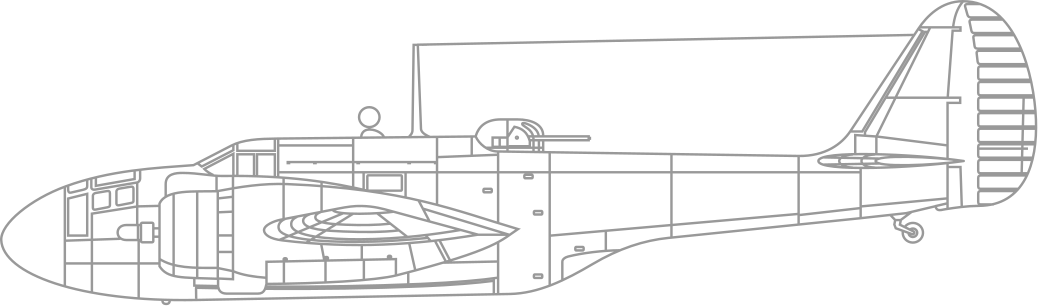
The aircraft on strength to this Squadron remained at 18. The following data is compiled on operational flying only. "Practice Bombing" and "Circuits and Bumps" flying hours have not been included.
50 hrs. Insp. Receipt Insp. Sorties Flying Hours
January 3 2 62 189.55February 6 Nil 114 292.05March 14 3 252 728.30During the greater period under review, heavy snow, frost necessitated the daily cleaning down of aircraft,
Handwritten Marginalia / Stamps: * Folio Number: 98 (Handwritten, Top Right). * Reference Stamp:The National Archives' reference AIR 27/271/399Page 2.Aircraft serviceability and performance were high as the followingdaily average shews :Serviceable Unserviceable.January 15 1February 17 1March 16 2Maintenance of Aircraft, Equipment, Plant etc. remained normal.
Aircraft spares required for servicing, on the whole, were suppliedsatisfactorily. During the three months' operations only oneaircraft was lost due to enemy action. The morale of the groundpersonnel was high in spite of the severe cold and, at times, thenecessary overtime that had to be worked. Beneficial results werenoted in personnel of the Squadron after leave trips to Rome andFlorence. Their food position too appears to be excellent, forthroughout this period, not a single complaint was lodged.The following report of the Armament Section embraces the months
of January, February and March. During the month of January only 7raids were carried out making a total of 62 sorties, during which201,000 lbs. weight of bombs were dropped. Conditions were extreme-ly bad during this month, and bombs had to be handled in snow, mudand rain, and a long distance had to be covered between the BombDump and the aircraft. Slightly better weather increased the numberof sorties flown in February to 114, during which a total weight ofbombs dropped amounted to 393,540 lbs. Mud and snow still had to becontended with, and the vehicles carrying bombs to and from theaircraft were frequently bogged. Co-operation of the M.T. Sectionand the Aerodrome Engineers enabled the work to continue success-fully. A vast improvement in weather conditions in March enabledthe Squadron to fly 252 sorties, dropping a load of bombs amountingto 983,330 lbs. During this month leave parties, three hospitalcases, three men on courses, and one posting depleted the establish-ment to an extent that a slight re-organisation had to take place toenable the work to continue successfully. The morale of theArmourers is high, although the majority of the men have seen twoyears continuous active service, and are feeling the need of Unionleave. The figures below show the results of three months work.Month Sorties Bombs dropped Weight Failures % F. to R.to ReleaseJanuary 62 345 201,000 lbs 8 2.3%February 114 2035 393,000 " 5 0.5%March 252 4218 983,000 " 8 0.3%--- ---- --------- --428 6598 1,577,000 lbs. 21During the period under review the Signals Section was
handicapped by the shortage of Wireless Mechanics. This was due tothe Section Strength being one under establishment and two Mechanicsbeing incapacitated as the result of an accident. In spite of thisthe serviceability of the aircraft did not suffer owing to the staffbeing extremely hard-working and keen. A high standard of aircraftserviceability has been maintained, and only on two occasions in thepast eight months has an aircraft been unable to take off due to awireless failure. A certain amount of trouble was experienced withthe SCR 522A Transmitter - Receiver, when the use of V.H.F. wasintroduced for interplane communication. This trouble was primarilydue to the very short life of certain receiver tubes. Trouble wasalso experienced with the delicate adjustment of the "Noise LimiterRelay". These difficulties have, however, been overcome and theresults now obtained are very satisfactory. A number of failureshave taken place with the SCR 274 N 6-9 Megacycle Command Receiver.These failures were caused by a breakdown of the output transformer.Four failures were experienced on the Liaison Receiver B.C. 348 dueto the burning out of the rotary transformer. It has been assumedthat the cause was overload due to circuit failures. The use oflow impedance American headsets and carbon throat microphones arebeing continued. In accordance with D.A.F. instructions allaircraft are being modified for the use of Air Ministry headsets andElectro-Dynamic Microphones. Five out of the nineteen aircraft areHandwritten Marginalia / Stamps: * Folio Number: 99 (Handwritten, Top Right). * Reference Stamp:The National Archives' reference AIR 27/271/3100Page 3.still to be modified. Regular and methodical maintenance is carriedout which has been responsible for the high standard of efficiencywhich has been maintained. It is extremely difficult for groundstaff to test equipment and obtain similar conditions to those whichexist when an aircraft is airborne. This difficulty has beenreduced to a bare minimum due to the whole-hearted co-operation ofthe aircrews. The intercommunication within the aircraft has beengreatly improved by the impedance matching of the output of the inter-phone amplifier to that of the headset in use. Generally speakingthe position is very satisfactory as regards to spares which isattributed to the excellent co-operation of 31 A.S.P.Serviceability of M.T. Vehicles reached a record high level this
month due partly to the acquisition of twelve new and two re-condit-ioned Three Tonners, and partly to improved weather which eliminatedthe terrible working conditions prevailing for the past five months.One cannot speak too highly of the unfailing perseverance and loyalservice of the Mechanics throughout the winter months when severalinches of mud comprised the only available "Workshop Standing".Many major repair jobs were carried out in these conditions, includ-ing engine changes, gearbox and clutch replacements. Every advantagewas taken of the nearby M.T. Salvage Dump for obtaining a largepercentage of parts used in our repairs. The Squadron is now up tofull Vehicle Strength, with the exception of one 1,000 Gallon PetrolBowser. M.T. Personnel present a problem at present, as severalDrivers and one Mechanic are awaiting Court Martial for allegedtheft of petrol, but the Squadron transport requirements are beingmet. Batteries and Headlamp Bulbs have been in extremely shortsupply as well as various Dodge items - i.e. points, starters,generators etc. These are now coming forward, but Chevrolet valvesare still unobtainable.The fact that there is a continuous request for more and more
additional N.M.C. labour shows that the part they play in theSquadron's War Effort is by no means negligible. On the Bomb Dump,in the Kitchens, in the M.T. Section - in fact nearly all groundstaff sections, N.M.C. soldiers are to be found. The general reportfrom the various Heads of Sections is that they are performing theirduties in a satisfactory manner. With the advent of warmer weatherthere appears to be a tendency among many of the N.M.C. to get outof camp more frequently. However, there have been few breaches ofdiscipline, and only isolated instances of drunkenness. The generalpractice of one day per week "off duty" has been carried out anddetails are allowed casual passes to Jesi. In the past monthopportunity was afforded the N.M.C. to go to the bi-weekly U.D.F.I.Cinema. Soccer is being played regularly and so far matches havebeen arranged between 30 Squadron, 24 Squadron and 3 Wing, S.A.A.F.A loudspeaker extension is provided in the Mess, so that the N.M.C.have the services of a radio. Approximately nineteen details attendeducational classes, and satisfactory progress is being made. AnE.P.I.P. tent serves the purpose of a classroom and it has all theappearance of a schoolroom. The weekly talk by Wing InformationSection is delivered by a N.E. attached G.E.S. and is always wellattended and greatly appreciated. In addition, several topical talkshave been given. Accommodation consists of 4\frac{1}{2} Nissen Huts and 4 -160 lbs. Tents. This is ample and allows a good measure of comfort.Rations are always ample and usually well prepared. No. 93997V.WS/S/Sgt. Groom J. S. was posted to No. 4 Aux. Transit Camp on 10thMarch, 1945 and was replaced by No. 224360V. WS/S/Sgt. du PlessisM. H. who joined the Squadron on 12th March, 1945.Major W.J.O. Musgrove and Comm. G.N. Dieu have been appointed
Flight Commanders of "A" and "B" Flights respectively.A Squadron Talent Concert was held during March and was a
great success. Lieut. Fraser and the Padre (Capt. S.R Skemp)Handwritten Marginalia / Stamps: * Folio Number: 100 (Handwritten, Top Right). * Reference Stamp:The National Archives' reference AIR 27/271/3101Page 4.are to be congratulated for their efforts in arranging this fineshow.The S.A. Concert Party "The Modernaires" gave a show in Jesi,also paid a special visit to the squadron and their bright, livelyshow was very much appreciated.A highlight of the month was the opportunity afforded by avisit of the Mobile Recording Van for 70 Officers and Other Ranks tobroadcast to the Union.Two unfortunate accidents took place in March. The first was a
"Runaway" Gun while an aircraft was on the ground when two WirelessMechanics were injured. No. 99935V A/Cpl. Skinner N.B. spent ninedays in hospital but is now back with the squadron. No. P.5429V.A/Sgt. Wilson B.D. is still in hospital and is progressing satis-factorily. A Court of Inquiry was convened and the findings will bepromulgated next month.No. 45245V. A/Sgt. Jamieson J.C. was involved in a motor cycleaccident and sustained severe injuries resulting in the amputationof his left leg. "Jimmy" was a very popular member of the Squadronand all were very sorry to hear of this accident. He is still inhospital but his condition is satisfactory. A Court of Inquiry wasconvened and a copy of the findings forms Appendix "AA"The news of Field Marshal Montgomery's offensive and the
progress of other armies on the Western Front, plus other successes,caused our already high morale to jump a further few points.OPERATIONAL SECTION.The month started off with a few days of duff weather, but on
the 3rd, the weather cleared and the Squadron started hitting out.The first raid was on the Conegliano Marshalling Yards. All
three boxes overshot, scoring direct hits on buildings in thevicinity.On the 4th, dock and shipping facilities were attacked at
Malfacone Harbour, with fair to good results.On the 8th, when a coal jetty was attacked at Arsa in the
Istrian Peninsula, one aircraft (Pilot : P/O. W.F. Blackford, (RAAF)Co-Pilot No. A. 419589 W/O Richardson W.H., Observer : Lieut. D. Smit,WO/AG : 1850403. Sgt. Arthur E.M. (R.A.F.) A/G : 1821494 Sgt. SmithD.S. (R.A.F.) A/G : 284246V. W.O.ii. Nel N.H.) received direct hitsby H.A.A. The aircraft crashed and four parachutes were seen toopen. Subsequently four members of the crew (Lieut. D. Smit,W/O. W.H. Richardson, W/O. N.H. Nel and Sgt. E.M. Arthur) assistedby Partisan guides, returned safely to Italy.Other targets of the month were - Factories at Ferrara,
attacked on the 7th - Ponto Longo Sugar Refinery on the 9th and 12th-Porto Nogara Cellulose Factory on the 18th. The Squadron alsovisited Yugoslavia - Zalog and Dobova Marshalling Yards being thetargets.Two Ammunition Dumps, one near Carsarsa and the other at
Malcontenta were bombed on the 19th and 25th respectively. On bothoccasion + 90% of bombs fell in target area causing terrificexplosions. At Malcontenta smoke rose to a height of 8,000 feet.On the first of these raids (on the 19th) the Squadron passed its1,000th sortie of Marauders.The Squadron did its first raid over Austria on the 21st when
it attacked the Marshalling Yards at St. Veit, north of Klagenfurt,with excellent results, doing great damage to trucks and lines in theyards. This target was again attacked with conspicuous success onthe 23rd, all three boxes of the formation scoring "Bulls".Handwritten Marginalia / Stamps: * Folio Number: 101 (Handwritten, Top Right). * Reference Stamp:The National Archives' reference AIR 27/271/3102Page 5.Between the 26th and the 30th Northern Italy had a spell of bad
weather and the Squadron was kept on the ground. On the 31st a breakin the weather afforded an opportunity to attack another MarshallingYard at Conegliano.During the month, the following Marshalling Yards in Northern
Italy were attacked twelve times, mostly with good results : Gemona,Casarsa, Gorizia, Conegliano and Pontebba, the latter being on theAustrian Border.Anti-Flak aircraft accompanied the Squadron on raids against
defended targets and proved a great success. These aircraft, goingin ahead of the formation to bomb gun positions with 20 lbs clusterbombs.Better results were also obtained by the use of a Windfinding
aircraft by the formation leading the Wing.By dropping 452,200 Pamphlets, containing mostly "Front Post"
and "News from the Home Country", assistance was given to the P.W.B.to carry on its psychological War against the enemy. The Englishtranslations of these pamphlets form Appendix "Z"242 Sorties, 722.50 hours were flown during the month and
852,360 lbs. of bombs were dropped. 7976 lbs. of Window weredispensed over enemy territory.Photographs of the majority of the operations carried out are
attached to the back of the Opreps forming Appendices to this Diary.A compliment to the squadron's bombing and photography was paid
when reproductions appeared in the February number of M.A.T.A.F.'s"Air Intelligence and Operations Bulletin".Two aircraft were sent to Naples to be fitted with "Shoran"
equipment and it is hoped that this equipment will soon be put touse. Already practice is being carried out. I have read over this diary and the facts are correct.
[Signed] D. Ord LT. COL. COMMANDING, NO. 21 SQUADRON, S.A.A.F.
[Signed] J. F. G. Kling LIEUT. DIARIST.
Handwritten Marginalia / Stamps: * Folio Number: 102 (Handwritten, Top Right). * Reference Stamp: